The Unsung Heroes of Stage Illumination: Understanding PAR Light Technology
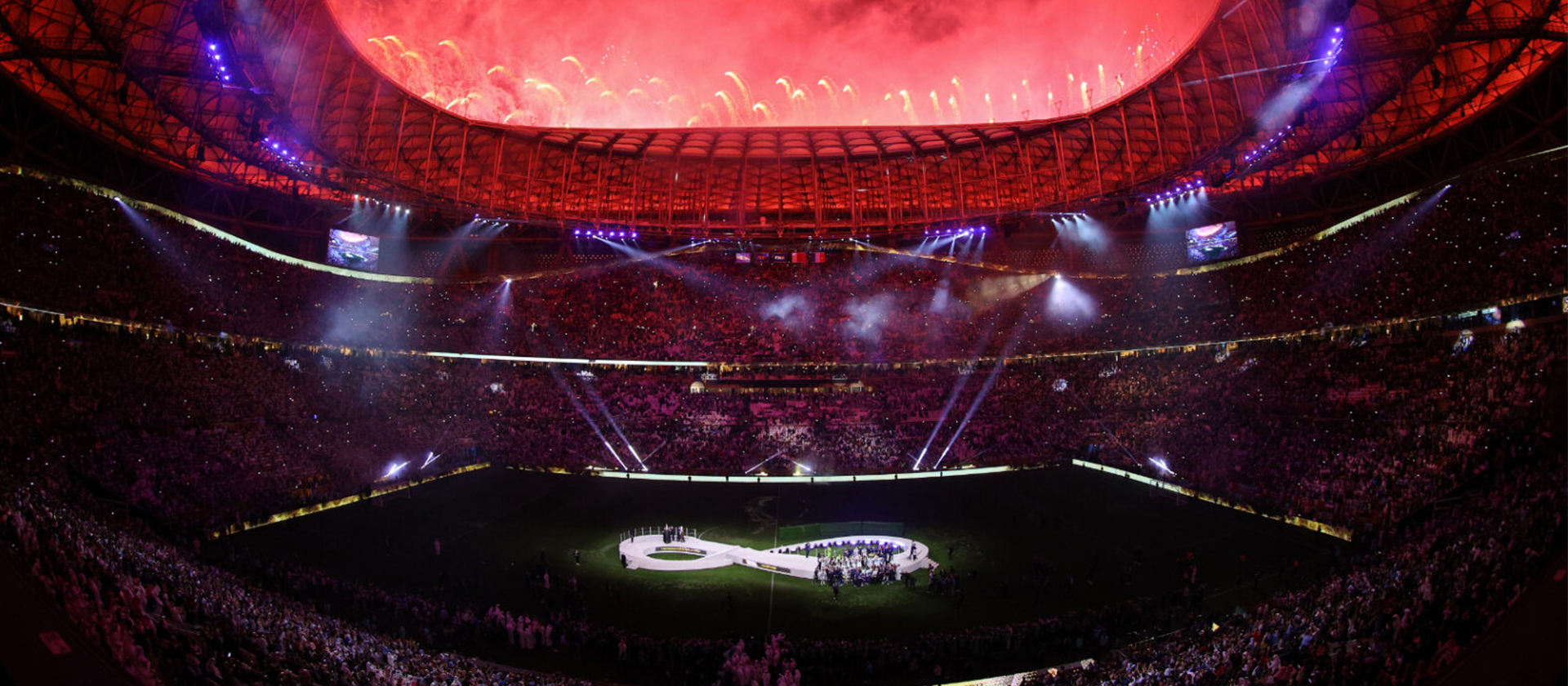
When the curtain rises at a major concert or theatrical premiere, audiences marvel at the dazzling array of colors sweeping across performers and sets. Yet behind every breathtaking visual moment lies a workhorse technology that production professionals have trusted for decades: PAR stage lights. These versatile fixtures have evolved from simple parabolic reflectors to sophisticated LED-powered instruments that define modern theatrical lighting design.
In 2025's demanding entertainment landscape, where live-streamed performances and hybrid events require flawless visual execution, understanding PAR light applications has become essential for production designers, venue managers, and touring companies alike. This comprehensive guide explores how PAR64 LED fixtures and their counterparts continue to dominate concert lighting equipment specifications while adapting to emerging creative and technical demands.
What Exactly Are PAR Lights? From Halogen Origins to Digital Innovation
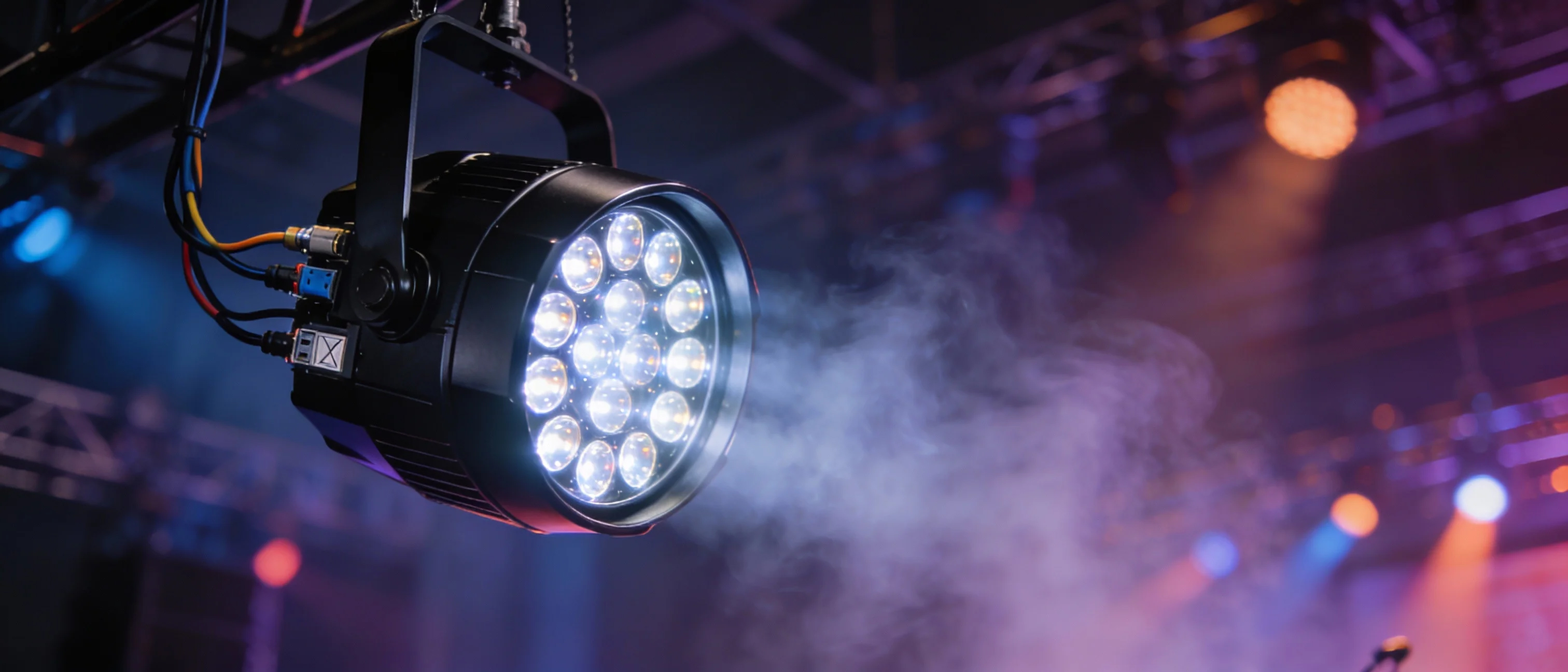
The term "PAR" stands for Parabolic Aluminized Reflector, describing the lamp's distinctive sealed-beam design that originated in automotive headlights before revolutionizing professional stage lighting. Traditional PAR cans housed incandescent or halogen bulbs within a parabolic reflector, creating intense, directional beams perfect for stage wash lighting and color saturation.
The LED Transformation
Modern LED PAR can lights represent a quantum leap forward. Today's fixtures eliminate fragile filaments and scorching heat, replacing them with robust diode arrays offering:
-
Energy efficiency up to 85% reduction in power consumption
-
50,000+ hour lifespans compared to 2,000-hour halogen bulbs
-
Instant color changes without gel filters
-
Daisy-chaining capabilities reducing cable clutter
-
DMX512 control for precise dimming and effects
The PAR Family: Navigating Sizes and Specifications
Understanding PAR nomenclature is crucial for specifying event lighting solutions. The number indicates bulb diameter in eighths of an inch:
PAR16 (2 inches)
Perfect for intimate DJ lighting setup applications and architectural accenting. These compact fixtures excel in close-proximity environments where space is premium.
PAR20 (2.5 inches)
The go-to choice for small clubs and gallery spaces, offering moderate output with minimal power draw.
PAR30 (3.75 inches)
Ideal for mid-sized venues requiring focused key lighting or patterned gobo effects.
PAR38 (4.75 inches)
The wedding and corporate event standard, balancing portability with substantial output.
PAR64 (8 inches)
The industry heavyweight dominating concert lighting equipment riders worldwide. These powerful fixtures create the iconic tight beams and broad washes seen in arena tours and major theatrical productions.
Real-World Applications: PAR Lights in Diverse Stage Scenarios
1. Rock Concerts and Music Festivals
Touring productions demand rugged reliability. PAR64 LED fixtures mounted on trusses create the signature "light blade" effects cutting through stage fog. Their ability to produce saturated reds and deep blues without color temperature shift ensures consistent camera coverage for live streams.
Case Study: The 2024 "Electric Horizon" festival utilized 180 RGBW PAR64 fixtures, reducing power requirements by 70% while achieving 16.7 million color variations synchronized to each performance's tempo.
2. Theatrical Productions
Broadway and West End shows rely on theatrical lighting precision. PAR cans provide:
-
Front-of-house washes ensuring even actor illumination
-
Specials highlighting solo performers
-
Cyc lighting for vibrant backdrop coloration
-
Cross-fade capabilities for seamless scene transitions
3. Houses of Worship
Modern churches embrace professional stage lighting to enhance worship experiences. PAR fixtures offer:
-
Silent operation crucial for spoken word segments
-
Warm amber tones flattering skin tones for broadcast
-
Volunteer-friendly interfaces simplifying operation
4. Corporate Events and Product Launches
Fortune 500 companies specify event lighting solutions that project brand colors accurately. LED PAR lights deliver:
-
Pantone-matched color output
-
Flicker-free performance for camera recording
-
Wireless DMX options for rapid venue reconfiguration
5. Nightclubs and DJ Booths
The quintessential DJ lighting setup integrates moving PAR fixtures for dynamic atmosphere control. Compact PAR20 units create booth ambiance while PAR38s sweep dance floors.
Technical Deep-Dive: Specifications That Matter
When evaluating concert lighting equipment, professionals prioritize these metrics:
Lumen Output and Efficacy
Modern LED PAR64 fixtures achieve 15,000+ lumens at 200W, delivering 75 lumens per watt—far exceeding 1000W halogen predecessors.
Color Rendering Index (CRI)
High-quality professional stage lighting demands CRI ≥90 for broadcast applications. Premium fixtures now offer CRI 95+ with R9 (deep red) values above 90.
Beam Angle Versatility
-
Narrow Spot (8-15°): Sharp gobo projections and long-throw specials
-
Medium Flood (25-40°): Versatile key and fill lighting
-
Wide Flood (60-90°): Broad stage wash lighting and cyc coverage
IP Ratings for Outdoor Use
Festival productions require IP65+ rated fixtures. Leading manufacturers now offer IP67 LED PAR can lights submersible to 1 meter for 30 minutes.
Dimming Curves
Smooth 16-bit dimming eliminates stepping. Advanced fixtures offer:
-
Linear for technical accuracy
-
Square law for perceived smoothness
-
S-curve for theatrical fades
Installation Mastery: Positioning Strategies for Maximum Impact
The Front-of-House Approach
Mount PAR stage lights at 30-45° angles from audience perspective. This positioning:
-
Eliminates harsh shadows on faces
-
Provides modeling dimension
-
Maintains audience sightlines
Backlighting and Rim Lighting
Position fixtures 60-70° behind performers to:
Cross-Lighting Technique
Pairs of PAR cans from opposite sides fill shadows while maintaining dramatic contrast—ideal for theatrical lighting where emotional impact is paramount.
Vertical Truss Configuration
Stacking PAR64 fixtures at 2-meter intervals on vertical truss towers creates "light curtains" for music festivals, allowing independent control of each fixture for chase effects.
DMX Control and Programming: Orchestrating Light
Modern event lighting solutions leverage complex DMX networks. A single universe (512 channels) can control 32 RGBW PAR fixtures with individual addressability.
Programming Best Practices
-
Group fixtures logically by position (e.g., "Downstage Left Wash")
-
Use palette-based programming for color and position presets
-
Implement proportional timing for realistic fade speeds
-
Create backup scenes for emergency contingencies
Wireless Integration
Cutting-edge productions deploy CRMX™ wireless DMX, eliminating 80% of control cabling. This technology proves invaluable for:
-
Temporary installations in historical venues
-
Outdoor festivals spanning multiple stages
-
Rapid load-ins where time is critical
Maintenance and Safety: Protecting Your Investment
Daily Operational Checks
-
Inspect lens cleanliness (smudges reduce output by 15-20%)
-
Verify fan operation on active-cooled models
-
Check DMX cable integrity
-
Confirm tilt locks and safety cables
Quarterly Deep Maintenance
-
Photometric testing to detect diode degradation
-
Firmware updates for feature enhancements
-
Lens inspection for cracks affecting beam quality
-
Power supply capacitance testing
Safety Protocols
Every concert lighting equipment rigging must include:
-
Secondary safety cables rated for 5x fixture weight
-
Load calculations verified by certified riggers
-
Locking carabiners on all hanging points
-
Ground fault protection on outdoor circuits
Economic Analysis: ROI of LED Conversion
Venues upgrading from halogen to LED PAR can lights typically achieve:
-
Energy savings: $3,200 annually per 20-fixture rig (based on $0.12/kWh)
-
Gel filtration elimination: $800/year savings
-
Labor reduction: 60% fewer lamp replacements
-
HVAC load decrease: 30% reduction in cooling costs
Payback period: 18-24 months for professional venues operating 40+ hours weekly.
Future Trends: Where PAR Technology Is Heading
Li-Fi Integration
Next-generation fixtures will transmit DMX data through visible light, eliminating cable interference entirely in DJ lighting setup environments.
AI-Driven Autofocus
Emerging professional stage lighting systems use machine learning to automatically adjust beam angles based on performer positioning captured by venue cameras.
Sustainable Materials
Manufacturers are transitioning to recycled aluminum housings and bio-based polymers, reducing carbon footprints by 40%.
Holographic Beam Shaping
Experimental PAR fixtures now manipulate beam shape through digital micro-mirror arrays, creating dynamic, morphing patterns without mechanical gobos.
Buying Guide: Selecting the Right PAR Lights for Your Venue
For Small Clubs (<200 capacity)
-
Budget: $150-300 per fixture
-
Spec: PAR38 RGB, 12x15W LEDs, 25° beam
-
Brands: Chauvet DJ, ADJ
For Mid-Size Theaters (200-800 seats)
-
Budget: $400-700 per fixture
-
Spec: PAR64 RGBW, 18x20W LEDs, 15-40° zoom, CRI >90
-
Brands: Elation, ETC
For Arena Tours (1000+ capacity)
-
Budget: $800-1,500 per fixture
-
Spec: IP65 PAR64, RGBWA+UV, 24x25W LEDs, pixel mapping
-
Brands: Claypaky, Martin Professional
Case Study: Broadway's "Neon Dreams" Musical
The 2024 Tony Award-winning production employed 156 PAR64 LED fixtures exclusively. Lighting Designer Jane Rodriguez notes: "We achieved 1,800 seamless cues using RGBW PARs with custom barn doors. The LED reliability meant zero lamp failures during 472 performances—a first in my 25-year career."
Their specification included:
-
Color temperature locking at 5600K for broadcast consistency
-
Fanless cooling for acoustic-sensitive scenes
-
Wireless DMX for rapid scenic changeovers
Common Mistakes to Avoid
-
Overlooking beam angle compatibility with venue throw distances
-
Ignoring CRI requirements for video recording
-
Underspecifying power distribution for full brightness operation
-
Neglecting lens cleaning schedules
-
Mixing fixture generations causing color inconsistency
Conclusion: Illuminating the Future of Live Performance
From intimate black-box theaters to sprawling festival main stages, PAR stage lights remain the cornerstone of professional stage lighting. The evolution from power-hungry halogen cans to intelligent LED PAR can lights exemplifies how classic tools can adapt to modern demands for sustainability, reliability, and creative flexibility.
As event lighting solutions grow increasingly complex, the humble PAR fixture proves that foundational design principles—robust construction, optical precision, and intuitive control—never go out of style. Whether you're specifying concert lighting equipment for a world tour or upgrading a community theater's theatrical lighting inventory, investing in quality PAR fixtures delivers returns measured not just in lumens, but in unforgettable audience experiences.
The next time you witness a performer bathed in perfect amber light or a concert explosion of synchronized color, remember: behind that magic stands decades of PAR light innovation, continuing to shape how we see stories unfold on stage.